The One Percent We Should Refuse to Accept
There is a number I have not been able to put down this week, and I think you should sit with it too.
Africa supplies roughly three-quarters of the world's manganese, seven-tenths of its cobalt and nearly a fifth of its copper — the irreplaceable inputs of the energy transition — and captures less than 1% of the value generated from manufacturing the clean energy technologies those minerals make possible. On the manufacturing step itself, our share is below 0.1%.
That finding does not come from an advocacy paper. It sits in Stepping Up the Value Chain in Africa, a report the IEA prepared at South Africa's request for the G20 in Johannesburg. The market it describes is not standing still: the combined value of six key clean technologies — solar PV, wind, batteries, EVs, heat pumps and electrolysers — has more than tripled from under USD 200 billion in 2015 to over USD 700 billion in 2023, and is headed toward USD 2.1 to 3.4 trillion by 2035 depending on how fast the world moves. Nor is minerals the only front: home to 18% of humanity, the continent also holds under 1% of the world's data-centre capacity. The pattern repeats wherever you look. The demand is ours. The endowment is ours. The value is someone else's.
I want to walk through what the IEA actually found, because it converts a familiar grievance into something more useful: a priced, sequenced opportunity.
Value is a ladder, not a lottery
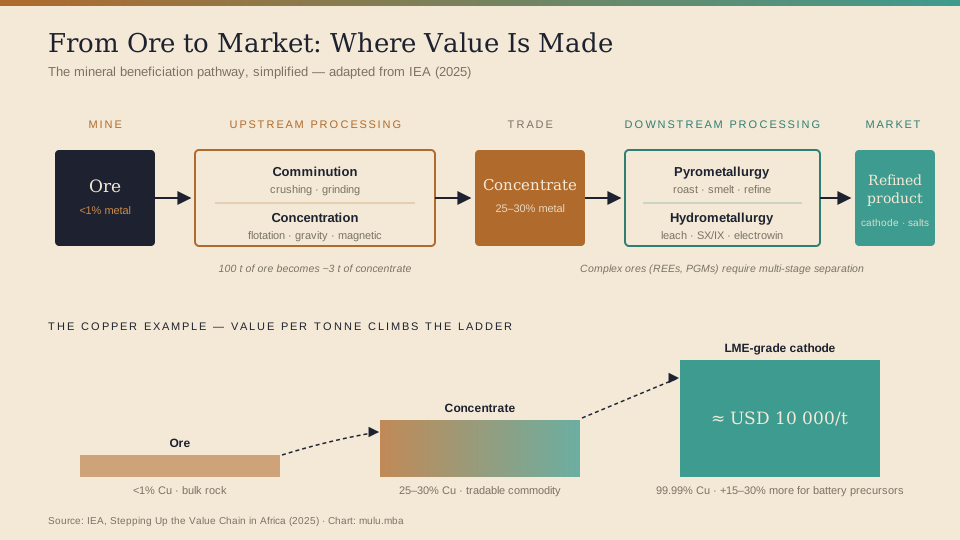
The first thing the report makes plain is that mineral value is created in steps, and we are standing on the bottom one. A typical copper deposit grades under 1% metal. Crush, grind and float it into concentrate and you hold a tradable commodity at 25–30% copper — and you have cut your transport bill by 97%, because only three tonnes of concentrate leave the gate for every hundred tonnes of ore mined. Refine that concentrate into 99.99% LME-grade cathode and each tonne commands around USD 10,000. Push into battery-grade chemical precursors and the market pays a further 15–30% premium.
Now hold that ladder against our current position: 97% of Africa's mined cobalt leaves the continent unprocessed. The DRC produces two-thirds of the world's cobalt and ships nearly all of it raw, primarily to China, where it becomes battery-grade material and someone else's margin, someone else's jobs, someone else's tax base. Every rung we decline to climb is value quietly handed across a border — and the report shows the continent's export basket has actually grown less sophisticated over the past two decades.
What climbing actually earns
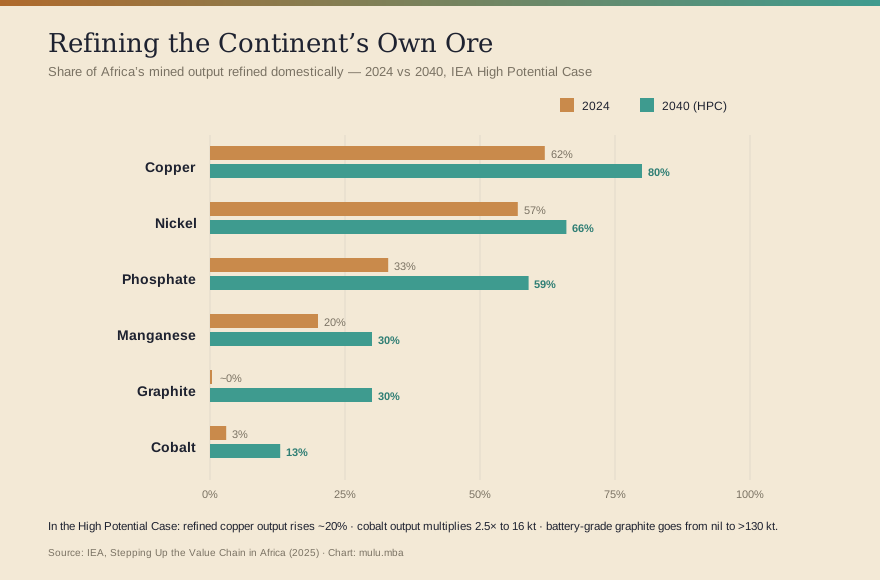
The IEA's High Potential Case models what happens if African countries put the enabling conditions in place. The targets are not fantasy: copper refined domestically rises from 62% of mined output to 80%; cobalt from 3% to 13%, with refined output multiplying two and a half times to 16 kilotonnes; battery-grade graphite goes from nil to more than 130 kilotonnes a year; phosphate refining nearly doubles to 59% of output.
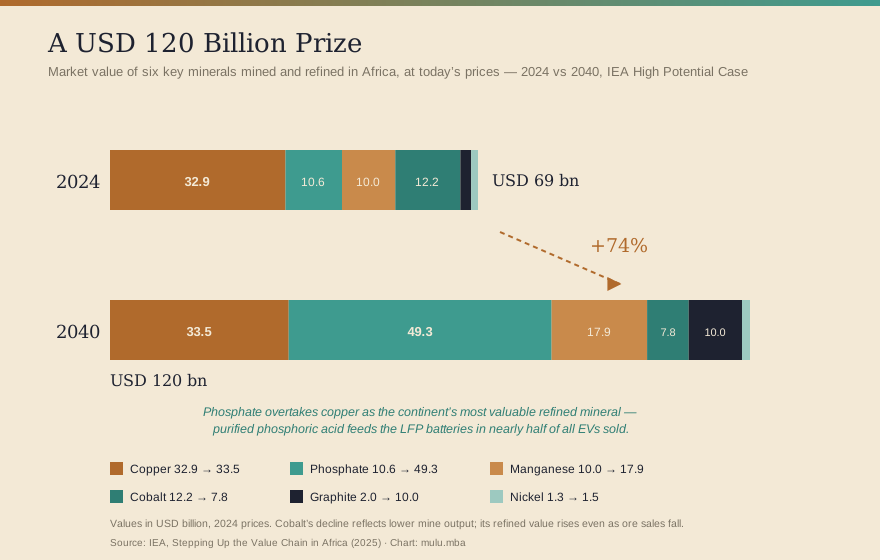
Priced at today's levels, the market value of these six minerals rises from about USD 69 billion to USD 120 billion by 2040 — a 74% expansion, against total African goods exports of roughly USD 680 billion today. Look closely at the composition and something remarkable emerges: phosphate overtakes copper as the continent's most valuable refined mineral, driven by purified phosphoric acid for the lithium iron phosphate batteries that now power nearly half of all electric cars sold globally. Morocco, holding the world's largest phosphate reserves, saw battery-related investment hit USD 15.3 billion in a single year. Beneficiation is not romance. It is arithmetic.
The empty map
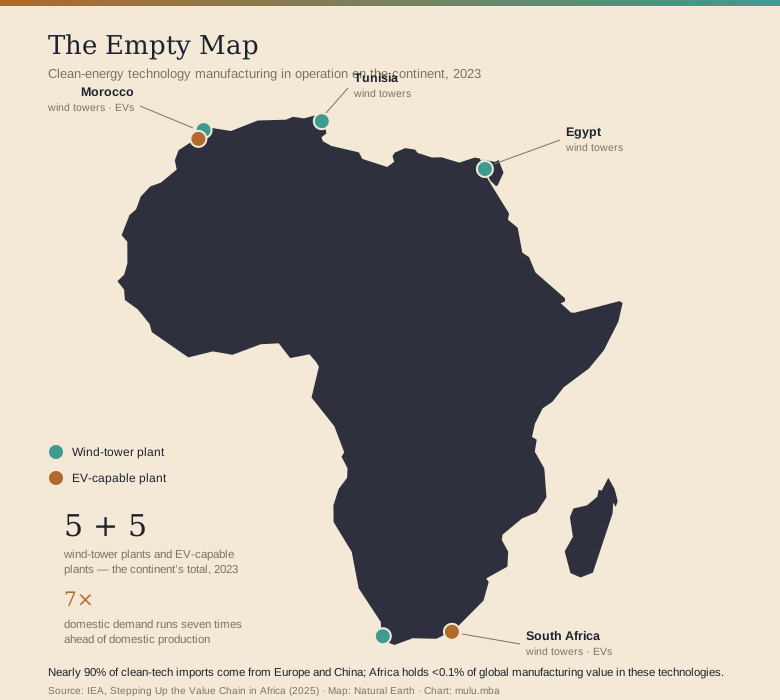
The most arresting image in the report is a world map of clean technology factories. Europe, China and North America are dense with markers. Africa is nearly blank: in 2023, the entire continent held five wind-tower plants — in Egypt, Tunisia, Morocco and South Africa — and five facilities capable of producing electric vehicles, all in Morocco and South Africa. Domestic demand for these technologies runs seven times ahead of domestic production, and nearly 90% of the imports filling that gap come from Europe and China.
Yet the same analysis shows the map is empty because of history, not geology. In the High Potential Case, African EV production rises from virtually nil to nearly 4 million vehicles a year by 2035, the continent becomes a net exporter by mid-century, and North Africa supplies 17% of Europe's cathode demand. Africa is already among the cheapest places on earth to build wind blades and EVs — cheaper than the European Union it would supply.
The honest part
So why hasn't it happened? The report is refreshingly unsentimental. Building a copper refinery in Africa costs over four times what it costs elsewhere. Energy makes up 44% of post-mining production costs — a quarter higher than in Latin America — because grids are unreliable and diesel fills the gaps. And capital is punishingly priced: the required equity return on a solar project runs 16% in Morocco and as much as 51% in Zambia, against 8–9% in Germany or Australia.
Strip everything else away and the whole question reduces to two variables: cheap, reliable power and cheap, patient capital. That is why energy policy is industrial policy on this continent — a refinery is, before anything else, an electricity contract. It is also why export bans alone will not do the work. Indonesia's nickel ban succeeded because it controlled the reserves and paired the ban with an investment case; several African bans have simply moved refining next door. Value is not forced up the ladder. It is financed up.
The window
What makes this decade different is that the global green build-out is being located now. The gigafactories, corridors and supply contracts signed between here and 2030 will calcify into a map that holds for a generation. If Africa enters that map as a quarry, it stays a quarry. If it enters as a manufacturer, one percent becomes a floor rather than a ceiling.
The IEA has done us the service of pricing the climb. The only real question left is whether we treat one percent as our station — or our starting line.
Source for all figures and data: IEA, "Stepping Up the Value Chain in Africa: Minerals, Materials and Manufacturing" (2025), prepared for the G20 under South Africa's presidency. Charts redrawn by mulu.mba.